


 Aotearoa - Neuseeland | Birding und Naturreise 2022

 REISEBERICHT
 Neuseeland
Written by Lutz und Uta Schmechta
Eine Natur- und Vogelbeobachtungsreise durch die Süd- und Nordinsel Neuseelands
Neuseeland – auf Māori Aotearoa – liegt abgelegen im südwestlichen Pazifik und besteht vor allem aus zwei großen Hauptinseln, der Nord- und der Südinsel, sowie zahlreichen kleineren Inseln. Landschaftlich ist das Land außerordentlich vielfältig: hohe Gebirge und Gletscher, Fjorde, ausgedehnte Wälder, Vulkanlandschaften, Seen, weite landwirtschaftlich genutzte Flächen und eine vielerorts noch ursprüngliche Küste prägen das Bild.
Auch die Geschichte der menschlichen Besiedlung Neuseelands ist vergleichsweise jung. Die polynesischen Vorfahren der Māori erreichten die Inseln nach heutigem Forschungsstand etwa zwischen 1250 und 1300. Der Niederländer Abel Tasman war 1642 der erste nachweislich bekannte Europäer, der Neuseeland erreichte. 1769 folgte der britische Seefahrer James Cook, der große Teile der Küsten erkundete und kartierte. Eine umfangreichere europäische Besiedlung begann schließlich im 19. Jahrhundert und nahm insbesondere ab den 1840er-Jahren deutlich zu.
Unsere Reise begann auf der Südinsel und führte uns anschließend über die Cook Strait auf die Nordinsel. Dabei wollten wir vor allem die unterschiedlichen Naturräume und die besondere Vogelwelt Neuseelands kennenlernen.
Die Karte gibt einen Eindruck von der Geographie des Landes und vom Verlauf unserer Route. Zwischen dem südlichsten Punkt unserer Reise, Stewart Island, und dem nördlichsten von uns erreichten Ort, Waipu Cove an der Ostküste der Nordinsel, lagen auf Straße und Fähre bereits rund 2.000 Kilometer. Bis zum Cape Reinga, dem äußersten Norden der Nordinsel, führte unsere Reise allerdings nicht.
Neben Stewart Island ganz im Süden besuchten wir auch Kapiti Island vor der Westküste der Nordinsel und unternahmen auf der Südinsel einen Abstecher zur Golden Bay.
Mit einer Fläche von rund 268.000 Quadratkilometern ist Neuseeland überraschend groß. Zum Vergleich: Italien umfasst etwa 301.000 Quadratkilometer. Wer Neuseeland bereisen möchte, sollte sich deshalb schon vor der Reise überlegen, welche Regionen und Landschaften im Mittelpunkt stehen sollen und wo man sich bewusst etwas mehr Zeit nehmen möchte.
Unser Ziel war es, unterschiedliche Naturräume, Regionen und Orte kennenzulernen. Dabei überquerten wir mehrere Gebirgspässe, erlebten die Tasmansee im Westen und den Pazifik im Osten und fuhren durch weitläufige landwirtschaftlich geprägte Gebiete. Auf der Nordinsel kamen wir auch durch größere Ballungsräume, die für uns allerdings weniger Reiseziel als notwendige Durchgangsstationen auf dem Weg zu unseren Beobachtungsgebieten waren – oder Orte, an denen wir die vorhandene Infrastruktur nutzten.
Und auch solche Etappen konnten durchaus zum Erlebnis werden: zum Beispiel bei Regen im ungewohnten Linksverkehr über die Harbour Bridge von Auckland zu fahren und anschließend weiter Richtung Norden in das wesentlich beschaulichere Waipu Cove.
Zusammenfassung
Unterwegs waren wir mit einem Camper-Van auf Basis des Toyota Estima, der umgebaut, sich auch zum Übernachten eignet. Er hat den Vorteil, dass er sich z.B. an kleinen engen Straßen wie ein normaler PKW fährt und es sich in den Städten leichter ein Parkplatz finden lässt. Teilweise übernachteten wir auch in B&Bs. Unsere Reiseagentur Travel Essence hatte für uns die Flüge, das Campercar, die B&Bs und einige wichtige Touren gebucht.
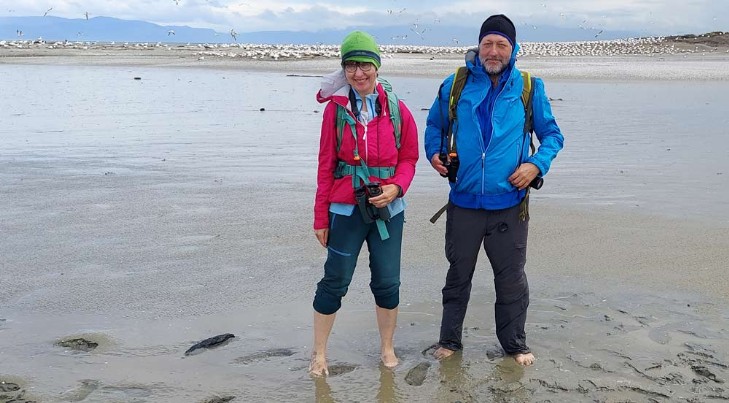
Bei einer Exkursion zur Kolonie Australischer Tölpel [Morus serrator] Australasian gannet am Farewell Spit in der Golden Bay auf der Südinsel Neuseelands.
Die Routen

 Auf unserer Wunschliste standen die Neuseeländischen nativen Vogelarten, Wale, Robben und die noch verbliebenen ursprünglichen Wälder und Naturräume.
Überrascht waren wir über die große Anzahl eingeführter Vogelarten. Z.B. waren Amseln und Singdrosseln gefühlt in jedem Lebensraum vertreten, Heckenbraunellen hüpften futtersuchend auf den Wiesen umher. Auch Birkenzeisige waren keine Seltenheit. Stare und vor allem auf der Nordinsel die Maynas waren häufig an den Straßenrändern zu sehen.
Die nativen Arten scheinen es in der Kulturlandschaft etwas schwerer zu haben und sind fast nur zu sehen, wenn etwas ursprünglichere Vegetation vorhanden ist. Auch scheinen sie etwas mehr unter den eingeführten Prädatoren wie Ratten und Possums zu leiden. Als Schutz- und Rückzugsgebiete sind gerade Inseln wie Stewart Island und Kapiti Island von Bedeutung, weil sie besser nach außen und innen hin kontrollierbar sind.
Auch werden auf dem Festland einige Bereiche durch hohe Zäune und gerodete Schutzstreifen geschützt. Z.B. auf dem Festland existierende Brutkolonien der Sturmtaucher oder in Wellington das Schutzgebiet Zealandia.
Wir sahen 101 Vogelarten davon 78 native Vogelarten und davon wiederum 57 endemische Vogelarten.
Darunter 3 Pinguinarten und 5 Albatrosarten, Sturmvögel und Sturmaucher.
Weiterhin: Seelöwen, Seebären, Große Tümmler, Schwarzdelfine, einen Finnwal, 2 Orcas und 1 Pottwal
Ganz besonders beeindruckte uns die Begegnung mit der Fairy Tern, der neuseeländischen Feenseeschwalbe. Mit Hilfe des Department of Conservation Whangārei konnten wir Neuseelands seltensten Brutvogel beim Fischen und Rasten zusehen, ohne zu stören.
Summary:
New Zealand – *Aotearoa* in Māori – lies in the south-western Pacific and is made up mainly of two large islands, the North Island and the South Island, together with numerous smaller islands. Its landscapes are remarkably varied, ranging from high mountains and glaciers to fjords, forests, volcanic regions, lakes, farmland and long stretches of largely unspoilt coastline.
The history of human settlement in New Zealand is relatively recent. The Polynesian ancestors of the Māori are thought to have arrived between about 1250 and 1300. In 1642, the Dutch explorer Abel Tasman became the first known European to reach New Zealand. He was followed in 1769 by the British navigator James Cook, who explored and charted large parts of the coastline. European settlement increased during the 19th century, particularly from the 1840s onwards.
We travelled through New Zealand from 27 October to 18 December 2022, beginning our journey on the South Island before continuing on to the North Island.
The map gives an impression of both the geography of the country and the route we followed. Between the southernmost point of our journey, Stewart Island, and the northernmost place we reached, Waipu Cove on the east coast of the North Island, we covered around 2,000 kilometres by road and ferry. We did not, however, make it as far as Cape Reinga at the northern tip of the North Island.
As well as Stewart Island in the far south, we visited Kapiti Island off the west coast of the North Island and also made a detour to Golden Bay on the South Island.
With an area of around 268,000 square kilometres, New Zealand is larger than it may at first appear. By comparison, Italy covers roughly 301,000 square kilometres. Anyone planning a journey through New Zealand is therefore well advised to decide beforehand which regions and landscapes they particularly want to explore and where they would like to allow themselves a little more time.
Our aim was to experience a variety of landscapes, regions and places. Along the way we crossed several mountain passes, saw both the Tasman Sea in the west and the Pacific Ocean in the east, and travelled through broad stretches of agricultural countryside. On the North Island we also passed through a number of larger urban areas, although these were less destinations in their own right than places we crossed on our way to birdwatching sites, or where we made use of the local infrastructure.
Even these stages of the journey had their own appeal. Driving across Auckland’s Harbour Bridge in the rain, while still getting used to left-hand traffic, was certainly an experience – especially knowing that not far beyond the city lay the much quieter surroundings of Waipu Cove.
 We travelled in a camper van based on the Toyota Estima, which is also suitable for overnight stays. It has the advantage that it can be driven like a normal car on small, narrow roads, for example, and it is easier to find a parking space in the cities. We also partly stayed in B&Bs.
 On our wish list were the New Zealand native bird species, whales, seals and the remaining original forests and natural areas.
We were surprised at the large number of introduced bird species. For example, blackbirds and song thrushes were present in almost every habitat, and dunnocks hopped around the meadows looking for food. Redpolls were also not uncommon. Starlings and, especially on the North Island, Maynas were often seen along the roadsides.
The native species seem to have a harder time in the cultivated landscape and are almost only seen when there is some more pristine vegetation. They also seem to suffer somewhat more from introduced predators such as rats and possums. As protection and retreat areas, it is islands like Stewart Island and Kapiti Island that are important because they can be better controlled externally and internally.
Also, on the mainland, some areas are protected by high fences and cleared conservation strips. E.g. on the mainland existing breeding colonies of shearwaters or in Wellington the protected area Zealandia.
We saw 101 species of birds, 78 of them native and 57 of them endemic.
Among them 3 species of penguins and 5 species of albatrosses, petrels and shearwaters.
Furthermore we saw sea lions, fur seals, bottlenose dolphins, black dolphins, a fin whale, 2 orcas and 1 sperm whale.
We were particularly impressed by our encounter with the Fairy Tern.
With the help of the Department of Conservation Whangārei, we were able to watch New Zealand's rarest breeding bird fishing and resting without disturbing it.